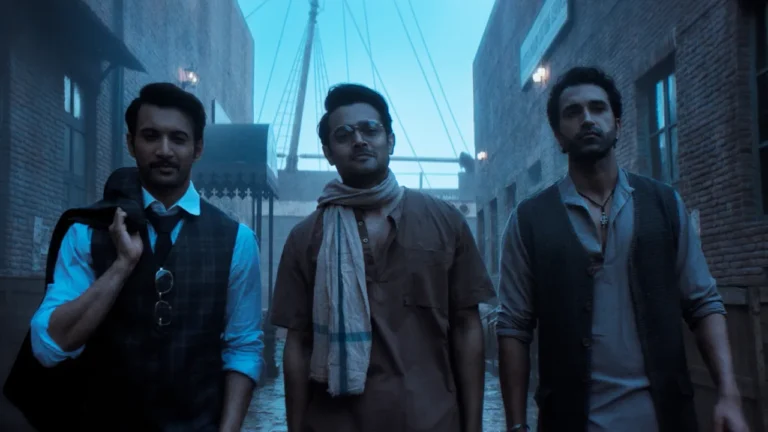

Hanuman Ansh (2026) Movie Review

The premise sounds almost too intimate for a mainstream theatrical release.
A boy loses his mother, refuses to accept the finality of it, and walks out of his own house looking for the one thing he thinks can undo death: God himself.
That is the seed from which Hanuman Ansh grows, and it is worth saying upfront that this isn’t a mythological spectacle dressed up as devotion.
It is a biographical drama, the first chapter of a planned trilogy, built around the early life of the man millions know today as Neem Karoli Baba.
If you’re the kind of reader who tracks smaller, faith-driven Hindi cinema alongside the bigger releases, this is exactly the sort of film MP4Movie exists to cover properly, away from the noise of opening-weekend box office charts.
Director Vishal Chaturvedi, a former doctor turned filmmaker, isn’t approaching this as an outsider telling someone else’s story.
The film is adapted from his own book, and by his own account the research stretched across more than a decade, taking him through Vrindavan, Akbarpur, Neeb Karori and Lucknow before a single frame was shot.
That kind of personal investment shows up on screen in ways both good and limiting, and I’ll get to both.
01The Setting and Setup of Hanuman Ansh
The film opens in pre-Independence India and follows young Lakshman Das after the death of his mother, a loss that sends him out of the house and into a search for the divine rather than into grief in the conventional sense.
What follows is less a plot in the three-act sense and more a procession of encounters, temples, forests, rivers, villages, each one nudging the boy closer to the understanding that would eventually define him as Neem Karoli Baba.
Young Lakshman Das
The death of his mother becomes the emotional starting point of his spiritual journey.
The Road Begins
He leaves home and encounters temples, forests, rivers and villages in search of the divine.
Neem Karoli Baba
The encounters gradually move him toward the understanding that defines his later life.
Chaturvedi resists the temptation to turn this into an origin story with a villain and a climax.
There isn’t a real antagonist here, which is a bold choice for a film that still runs two and a half hours, and it puts enormous pressure on tone and performance to keep the audience invested scene to scene.
The casting story behind the lead is genuinely unusual and worth mentioning, because it shapes what you see on screen.
Shobhinaw Satyaa was originally the film’s second assistant director, and stepped into the title role only after the actor initially cast fell ill during the first shooting schedule in Chitrakoot.
Shobhinaw Satyaa
Originally the film’s second assistant director, Satyaa stepped into the title role after the initially cast actor fell ill.
That’s not a footnote you’d usually build a review around, but it matters here because Satyaa’s performance doesn’t carry the polish of someone who trained for months to play a saint.
It carries something closer to sincerity, which is either the film’s biggest strength or its most obvious limitation depending on what you walked in expecting.
02What Works
The film’s best instinct is restraint.
Chaturvedi keeps the emotional register low and steady rather than pushing for the swelling, tearful crescendos that devotional dramas usually reach for.
Grief here is quiet, and so is faith, and there’s a version of this film that could have leaned hard into melodrama and didn’t.
Unforced Simplicity
Satyaa plays the character with an unforced simplicity that suits the material.
Natural Performances
The younger actors around him, particularly Vihaan Shedge in the teenage portions, don’t overplay their scenes either.
Chitrakoot
Location work in Chitrakoot gives the film a texture that a studio backlot never could.
Practical Elements
The Hanuman idol installation and Baba’s cave were built on location rather than faked digitally.
Satyaa plays the character with an unforced simplicity that suits the material, and the younger actors around him, particularly Vihaan Shedge in the teenage portions, don’t overplay their scenes either.
Location work in Chitrakoot gives the film a texture that a studio backlot never could, and the choice to actually build practical elements like the Hanuman idol installation and Baba’s cave on location rather than fake them digitally pays off in small, tactile ways.
The devotional soundtrack does a lot of quiet heavy lifting too, functioning less as background score and more as connective tissue between scenes that otherwise have very little conventional narrative momentum.
03Where It Falls Apart
Here’s where I have to be honest about the budget, because it is impossible to separate this film from its ₹2 crore production cost, and the film doesn’t always disguise that limitation well.
Some stretches, particularly in the film’s back half, feel less like a theatrical drama and more like an extended documentary reenactment, unhurried to the point of testing patience even for viewers who came in receptive to a slow, meditative pace.
The bigger issue for me is a structural one rather than a technical one.
A story about a man who taught that devotion is service, not spectacle, keeps reaching for spectacle anyway, leaning on staged miracles rather than sitting with the harder, more interesting question of what the search for God actually costs a person internally.
Devotion
The film is strongest when it embraces quiet, sincere and unhurried moments of spiritual searching.
Spectacle
The film becomes less certain of itself when it dresses the spiritual journey in staged miracles.
That’s a real tension in the film, and it’s one Chaturvedi never quite resolves, because the moments where Hanuman Ansh is strongest are the plain, unhurried ones, and the moments it seems least sure of itself are the ones dressed up as miraculous.
Supporting characters, including Chandan Anand’s Bhonsle, get thin characterization, existing mostly to react to the protagonist rather than to pull their own narrative weight, which flattens the middle stretch of the runtime.
04Music and Sound
The soundtrack leans entirely into devotional territory, and that’s the correct instinct for a film like this rather than a limitation.
Devotional Soundtrack
The music stays committed to the film’s spiritual identity instead of chasing commercial hooks.
Ambient Sound
Forest and river sounds quietly add emotional weight to the outdoor sequences.
Consistency
The lack of commercial distractions keeps the soundscape aligned with the film’s devotional intent.
There’s no attempt to modernize the sound with a commercial hook or an item number shoved in for marketing, which some viewers might read as a lack of ambition, but I’d call it consistency.
Where the sound design genuinely helps the film is in the quieter outdoor sequences, where ambient forest and river sound does more emotional work than the dialogue around it.
05Does It Come Together
Mostly, yes, though with real caveats.
As a standalone theatrical experience measured against slicker devotional hits it’s inviting comparison to, Hanuman Ansh doesn’t have the scale or the technical confidence of something like Mahavatar Narsimha, and it knows it, which is why it wisely never tries to compete on those terms.
What it has instead is sincerity, and for a large section of its audience, sincerity has clearly been enough.
What it has instead is sincerity, and for a large section of its audience, sincerity has clearly been enough.
The film’s real-world trajectory backs this up.
According to reports covering its release, the modestly budgeted film grew from a small opening into a sleeper hit through positive audience word of mouth, which tells you something the reviews alone can’t. Nera News
This isn’t a film chasing multiplex spectacle audiences.
It’s chasing, and largely reaching, the audience that already has a personal connection to Neem Karoli Baba and Kainchi Dham, and for that audience, the film’s unpolished honesty is probably the entire point rather than a flaw to forgive.
06Who Should Watch This
If you have any existing devotion toward Neem Karoli Baba, or an interest in Indian spiritual biography told without commercial gloss, this is worth your time and probably worth watching in a theatre with an audience that shares that intent, because the communal experience seems to be doing real work here.
The Ideal Audience
This film is best suited to viewers who value sincerity, spiritual biography and a slower cinematic rhythm over spectacle.
If you’re coming in purely for production value, visual scale, or a tightly plotted biographical drama, temper your expectations, because the ₹2 crore budget is visible throughout, and the film asks for patience it doesn’t always earn in its slower second half.
As the opening chapter of a planned trilogy, Hanuman Ansh works better as a promise than as a complete statement, sincere in its intentions, uneven in its execution, and clearly more interested in devotion than in filmmaking craft for its own sake.